
Get Healthy!
- Posted January 7, 2026
Sleep Lab Data Can Predict Illnesses Years Earlier, Study Finds
Your body is talking while you sleep, and what it’s saying could help doctors predict your future risk for major diseases, a new study says.
An experimental artificial intelligence (AI) called SleepFM can use people’s sleep data to predict their risk of developing more than 100 health problems, researchers reported Jan. 6 in the journal Nature Medicine.
SleepFM excelled at predicting conditions as varied as cancers, pregnancy complications, heart problems and mental disorders, the study reported.
It also could predict a person’s overall risk of death, researchers noted.
“SleepFM is essentially learning the language of sleep,” co-senior researcher James Zou said in a news release. He’s an associate professor of biomedical data science at Stanford Medicine.
Researchers trained the AI on 585,000 hours of sleep data from 65,000 people who’d had their sleep monitored at a sleep center.
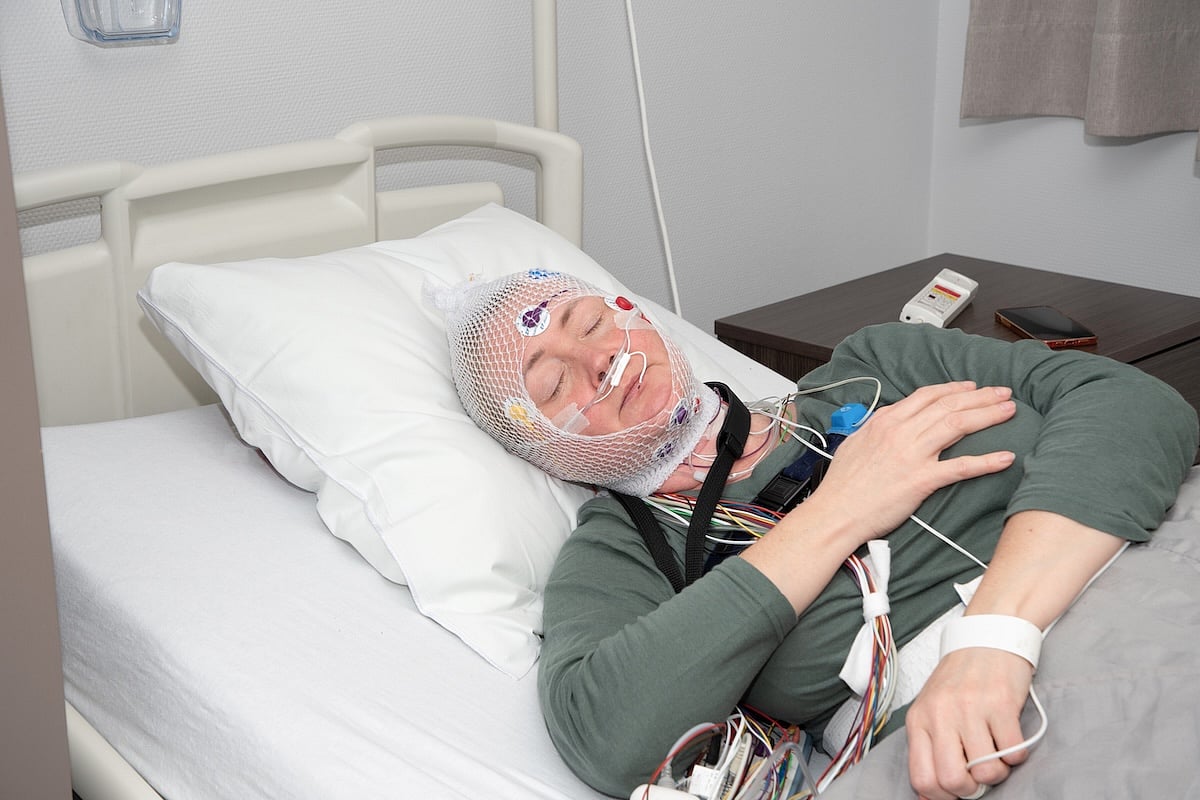
These comprehensive sleep assessments record brain activity, heart activity, breathing, leg movements, eye movements and more, researchers said.
“We record an amazing number of signals when we study sleep,” co-senior researcher Dr. Emmanuel Mignot, a professor of sleep medicine at Stanford, said in a news release. “It’s a kind of general physiology that we study for eight hours in a subject who’s completely captive. It’s very data rich.”
The team then used long-term data from the Stanford Sleep Medicine Center to tie sleep data to health risks. About 35,000 patients went to the center for sleep assessment and were followed for up to 25 years.
SleepFM analyzed more than 1,000 disease categories in the patients’ health records, and found 130 that could be predicted with reasonable accuracy by their sleep data, researchers said.
They used a statistic called the C-index, or concordance index, to test the AI’s ability to predict diseases. A C-index of 0.8 or higher shows it can predict disease accurately.
“A C-index of 0.8 means that 80% of the time, the model’s prediction is concordant with what actually happened,” Zou said.
SleepFM’s predictions were particularly strong regarding Parkinson’s disease (C-index 0.89), dementia (0.85); hypertensive heart disease (0.84); heart attack (0.81); prostate cancer (0.89); breast cancer (0.87); and death (0.84).
“We were pleasantly surprised that for a pretty diverse set of conditions, the model is able to make informative predictions,” Zou said.
The team found that there was some cross-talk when it came to the heart and head while sleeping.
Heart signals during sleep factored more prominently in heart disease predictions, while brain signals did so with mental health predictions, researchers said. However, combining all the data coming in produced the most accurate predictions.
“The most information we got for predicting disease was by contrasting the different channels,” Mignot said. Sleep data that appeared out of sync — a brain that looks asleep but a heart that looks awake, for example — seemed to spell trouble for a person’s health.
The team is now working on ways to further improve SleepFM’s predictions, possibly by adding data from other devices such as wearables.
Researchers also are trying to better understand what SleepFM is looking at when it makes its predictions.
“It doesn’t explain that to us in English,” Zou said. “But we have developed different interpretation techniques to figure out what the model is looking at when it’s making a specific disease prediction.”
More information
The Sleep Foundation has more on sleep lab studies for patients.
SOURCE: Stanford Medicine, news release, Jan. 6, 2026


